The worlds we create belong to some reality. Those realities must have some form of physics that governs the actions within. These physics must be the type that can create and sustain life or at least things that are capable of having and conveying experiences within that reality. No characters, no story. These factors combined with our limited imaginations as 3D, corporeal, mortal beings means that the realities we create are almost always analogous to our own.

So what does this mean for our writing? It means the world, our real world, is a treasure trove of inspiration. If our writing is doomed to be analogous, why not hunt for some bitchin’ analogs!

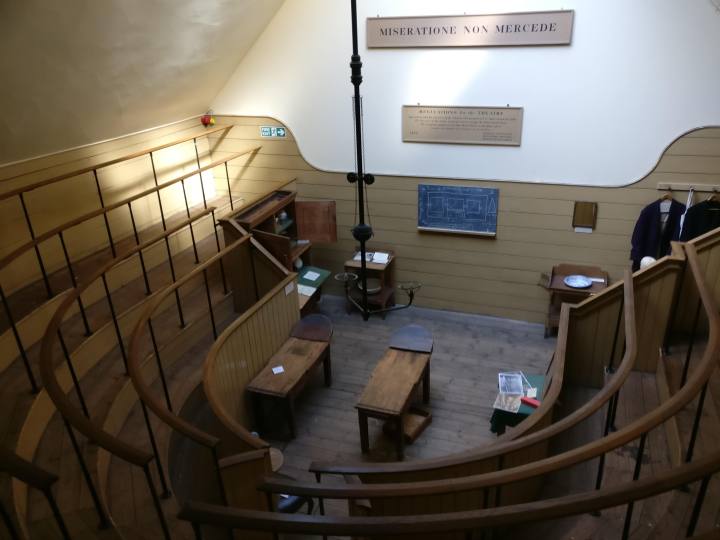
I’m a lucky man and I get to travel a lot thanks to my rad wife’s rad job. Wherever we go, I always like to keep an eye out for intriguing settings or details from scenes that could one day make it into my stories. IMG_20190411_135351This, for example, is an actual Victorian surgical theater smack dab in the middle of London. As a writer of mostly dark themes, I had to check this place out. Who knows when one of these rooms will creep into a story. So, I hopped on the tube and bought my ticket and hauled myself up the narrow stairwell, through the gift shop, and up to the vantage point where I took the photo. That photo, however is just the tip of the iceberg when it comes to the way I go about scene collecting. (more…)
I’m excited to announce I’ve just had another article published in The Woolf, Zürich’s premier English language e-magazine on writing.

Writers are very used to thinking about the various styles of POV as means to deliver information but often ignore their power to hide it. In the Masks edition of The Woolf, I take a deeper look at POV as a tool for mystery and subterfuge. If you’re interested, follow the link below.

MASKS

I feel different. Not much, but enough to notice. Change in people tends to happen in one of two ways, fast and drastic or slow and gradual. My change was neither. It was a small yet vivid moment of self-awareness and it was all thanks to Museum Vrolik.

My wife and I recently met up with our friends the Alexanders (writer K.M. Alexander and artist Kari-Lise Alexander). We were in Amsterdam for a good dose of adventure and shenanigans. As avid Atlas Obscura users, the Alexanders came prepared with a list of lesser known must-see’s and one of those was Museum Vrolik, the University of Amsterdam’s anatomical and embryological collection. This museum focuses on teratology or the study of deformity.

Science and history, especially old teaching tools and aides have always fascinated me and I jumped at the chance to see, first hand, the specimens used by the doctors and researchers of old.

As we entered the main door and the collection came into view, a feeling settled over me. It was a deep feeling of reverence. This was not going to be a fun experience. Most the specimens at Museum Vrolik save for a small collection of animals, are real human beings or parts from a real human being, preserved for study, learning, and research. As I took in each deformed foetus, dissected hand, or deformed skull, it was clear just how much respect the situation and the people behind the glass deserved. These people were not there for amusement. They existed to help others discover new ways to treat or prevent the afflictions that ultimately killed them. It was evident that for many in the museum, life, if they ever lived at all, was suffering.

I often feel the importance of a place but rarely experience the power. Museum Vrolik made me understand both. My time among the Siamese twins, elephantiasis ravaged bones, and flayed appendages was fascinating, awe-inspiring, and thought-provoking but it could never be deemed as”fun.” Was it enjoyable? Yes, but it’s important to remember that enjoyment isn’t always linked to a sense of pleasure. I felt intellectually satisfied. That’s a feeling I always enjoy.

I say that I was changed that day and in one specific way, I was. I realized why I have an affinity for the macabre. I realized the underlying impetus that drives me toward places like Museum Vrolik. It is the opportunity to learn from things so unlike me and my everyday life. It is the opportunity to experience aspects of reality that I hadn’t or couldn’t before. I will always take a window over a door, even it shows me the dark rather than the daylight.