It’s been a while. I thought it would be prudent to jump back into blogging with an update on my writing projects.

The Coals

My first novel had been making the rounds with agents for the first three months of the year. I wasn’t picked up by anyone but I did have some encouraging feedback. I heard from more than one agent that while the premise was intriguing, the intro just didn’t grab their interest. I was left with two decisions.

A. I could stay true to my pure artistic vision.

or

B. I could understand my status as a growing writer and check into their concerns.

I chose B. Lo and behold, my intro did indeed suck. It’s a good reminder that sometimes a writer can be too close to their own work. A little time and a nudge from other sets of eyes can make all the difference. In addition, my genius wife came up with a fix for another minor but nagging problem within the story. That fix combined with new intro chapters and a rewrite of the first third of the novel equated to both a lot more work and what I feel is a much better story. The query letters have begun to flow once more so, here’s hoping.

The Stable (working title)

This is my second novel and I’m currently 40,000 words in. I’m not happy with the foundation I’ve laid for the story so I’m in the midst of a massive revision. I should be moving on with new chapters by the end of next week.

Radio(working title)

Novel three has it’s first chapter written and is in the initial planning stages. I’m on schedule to begin writing in earnest in early September.

The Troll

I have a short story that has been accepted into an anthology. More details on that in the comings weeks and months. What I can report right now is that I’m very excited to be included.


There you go. That’s what I’ve been doing. It’s good to be back and keep an eye out for more posts as I get back into the blogging groove.
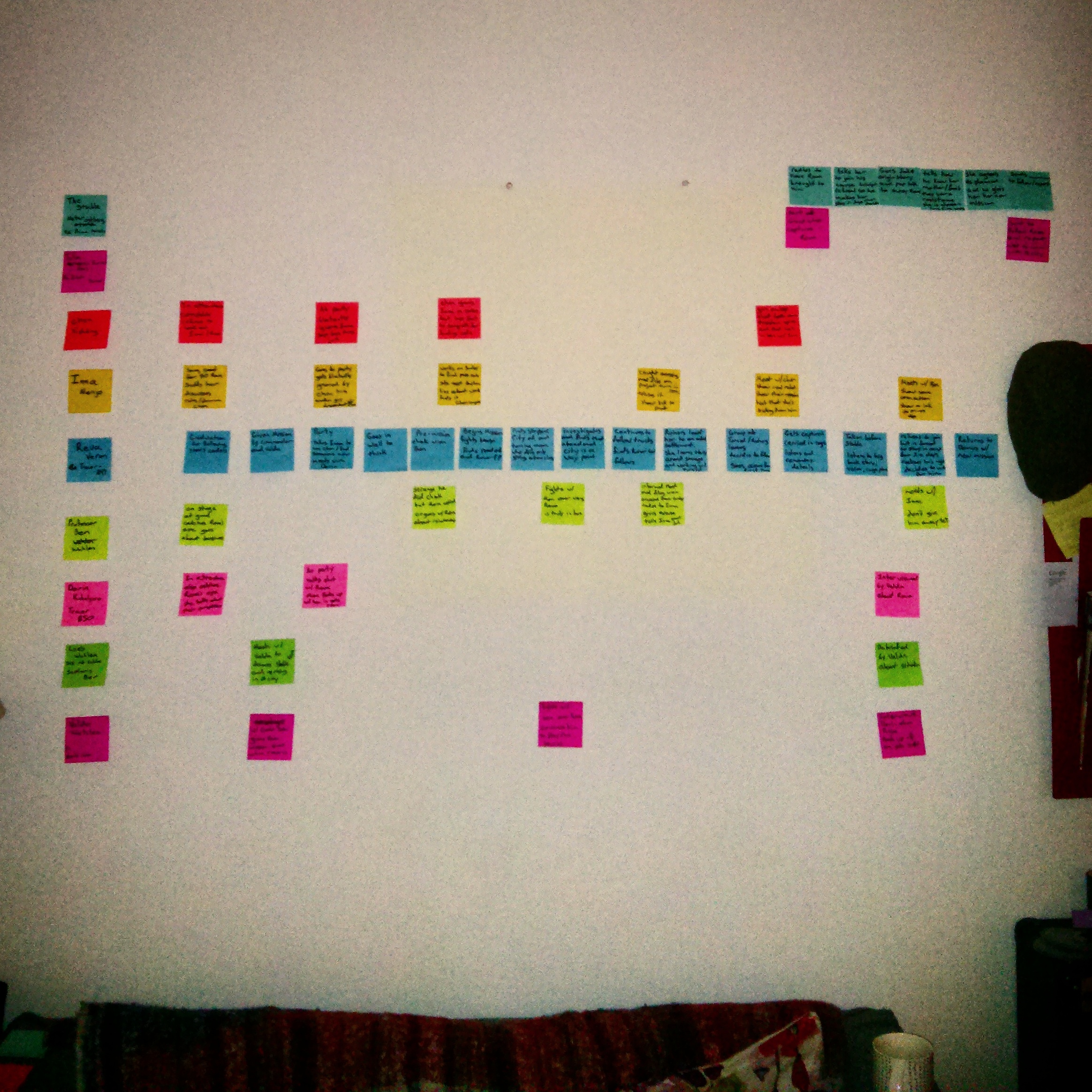
So a few months ago I got all excited and filled an entire wall of my apartment with multicolored sticky notes. It was beautiful and oh so satisfying to step back and see all of the planning I had just done. The problem was that there was no way I could make that process sustainable. It required too much paper, too much wall space, and too much time.

Sticky note wall

As I usually do, I wrote to my good friend, author of The Stars Were Right and Old Broken Road, K.M. Alexander to show off my masterwork. As he usually does, he gave me a great suggestion for a better tool. We both use Scrivener  as our primary word processor and the company who makes it also makes a helpful little gem called Scapple. It’s essentially a digital sticky note wall but with so many more great features.

Scapple Example

Sorry about obscuring the notes but I can’t go and give away my secrets now can I?

Anyway, this is just a small example of what you can do with Scapple. I’ve got the main characters on the left and I use lines to track their appearances throughout the scenes. The dark rectangles represent chapters and the stickies inside detail the general actions of each character that shows up in that chapter. I’ve also got some things going on with arrows but they are hard to see in the picture so we’ll just ignore that part.

I’m still somewhat new to the program so there is a lot I have yet to learn. Also, if you aren’t a fan of my green background, don’t worry, the default is white and you can either choose solid colors or use photos as a backdrop.

I’m not going to go into too much detail about the program as its website does a great job describing its many functions.

Scapple is available from good people at Literature and Latte. It’s affordable and you can download a free 30-day trial. In this case, each day you open the program counts as one of your thirty days so conceivably you can stretch the free trial out for much more than just a month.


I’m not working for Literature and Latte nor am I endorsed by them. This isn’t meant to be a commercial. Their products just kick ass and have made my writing life much easier so I thought I’d spread the word. Give it a try. Or don’t.

Cast in the amber glow of a solitary lamp, the lone writer lays pen to paper. Their words flowing from one mind to create one story. This monolithic narrative stands as an unsullied testament to the author’s creative genius. The bound pages, smelling of ink and glue, are passed from author to reader in direct communication of art and idea.

Nope. Stop. That’s not how it works.

I think many people have an impression of writers as this Thoreau-esque figure, stuffing themselves away in the woods or a closet somewhere far from the influence of others. It’s true that some do. Maya Angelou famously rented a hotel room for use as a personal work space each time she had a new project. For most writers however, the isolation of writing only exists during the time keys are clicking and ideas are flowing. Also, when we stare into the abyssal blank document with its taunting cursor, frozen, scared, so alone…

It’s the eyes and thoughts of others, either during or directly after the drafting process, that help the author pound their work into its final, beautiful glory. This feedback comes in many forms. Be it from writing groups, alpha readers, beta readers, agents, editors, or even just frantic, late-night emails to a friend, each has a place and a specific use.

Living in a foreign country where I do a piss-poor job speaking the language (sorry France, I’ll try harder), I’m more isolated than many writers. Still, I’ve been lucky enough to find a place in three different writing groups. Two face-to-face groups here in Paris and one online group. Each provides me with a unique take on my work.

The first of my in-person writing groups has a few regulars but is mainly a rotating cast of authors from multiple genres and at multiple skill levels. This group helps me understand how my work relates to a wide audience. Much of the feedback is useful but not all, so I have to think about what’s been said and who’s said it. I’d like my work to sit well with a broad readership but I have to remind myself that the audience I’m actually writing for is much more specific and that I can’t please everyone.

My second flesh and blood writing group consists of five unchanging members. We all write in closely linked genre’s and the feedback I receive is more laser focused. It’s still my work and so I have to weigh their comments but more often than not, the critique is sound. This group acts more or less like alpha readers.

My final group is an online writing group. Critiques do take place but it acts more like a community than a traditional writing group. Picture a cul-de-sac where each house contains a writer. Various writers pop out of their front doors and chat with the neighbors about what’s going on, interesting things they’ve come across, the latest news, etc. Those same neighbors also talk shop and are able to understand what we are all going through as writers. They offer encouragement and condolences, thoughts and ideas.

Writing groups aren’t for everyone. It can often just boil down to dumb luck. Some groups are supportive, nurturing, and helpful. Others are just plain toxic. Do you need a writing group? No, but I’ve found some I love and I’m sticking with them. What you absolutely do need is are at least a few people who can look at your work and see the flaws that we as authors are often blind to. We need others to spot typos, point out logic flaws, and pin targets on the backs of our darlings. The best we can do and the best our work can be are rarely the same thing.

If you are someone who plans on being a solo writing, editing, and publishing three-ring circus, all I can say is good luck.