Your eyes suck.

No, not like they’re damaged or whatever. I mean maybe… If so… sorry about that. (Insert awkward staring at the floor here)

What I mean is that as a writer, you have a set of mental filters that actually keep you from seeing your writing for what it is. What it truly is.

Some writers, have the sparkle and shine filter that makes their work look as polished and ready for print as the fifteenth draft of some Cormac McCarthy novel. Most, have the broken and muddy filter that makes their work seem like it was scrawled on a cave by the idiot brother of the lady in charge of the good cave painting. Some carry both or even other, more rare filters fuelled by other, more rare neuroses.

Regardless, if your eyes are the only set that ever look at what you’ve written, than the truth about your work will always be obscured by whichever default filter(s) your brain possesses.

Thankfully, there is an easy-ish fix. Let other people read your work and listen to what they have to say.

Waitnothat’stooscarywhatiftheyhateit?Whatiftheyhateme?WhatifIlooklikeafool?Whatif…

Calm down, I said easy-ish. If you’ve never before let someone read your work, chances are some form of the above panic has crossed your mind. Handing over your word-child to be scrutinized by another can be a terrifying prospect. The thing is, in almost all situations, those worries aren’t justified.

You see, before others can actually read your work, they have to AGREE to read it. If you choose the people who critique your work carefully, then you’ll find that they’re almost always excited to read what you’ve written. So let them. Oh, and make sure you ask for feedback. Smiles and back slaps make for fuzzy feelings but notes and critique make for better writing.

“Notes and critique?” you ask.

Yup. Welcome to the land of alpha and beta readers. In part two and three I’ll talk about why they’re important to your writing and why being one for others is just as important. Stay tuned.


Click here to read more about my take on the importance and benefit of beta reading for others.
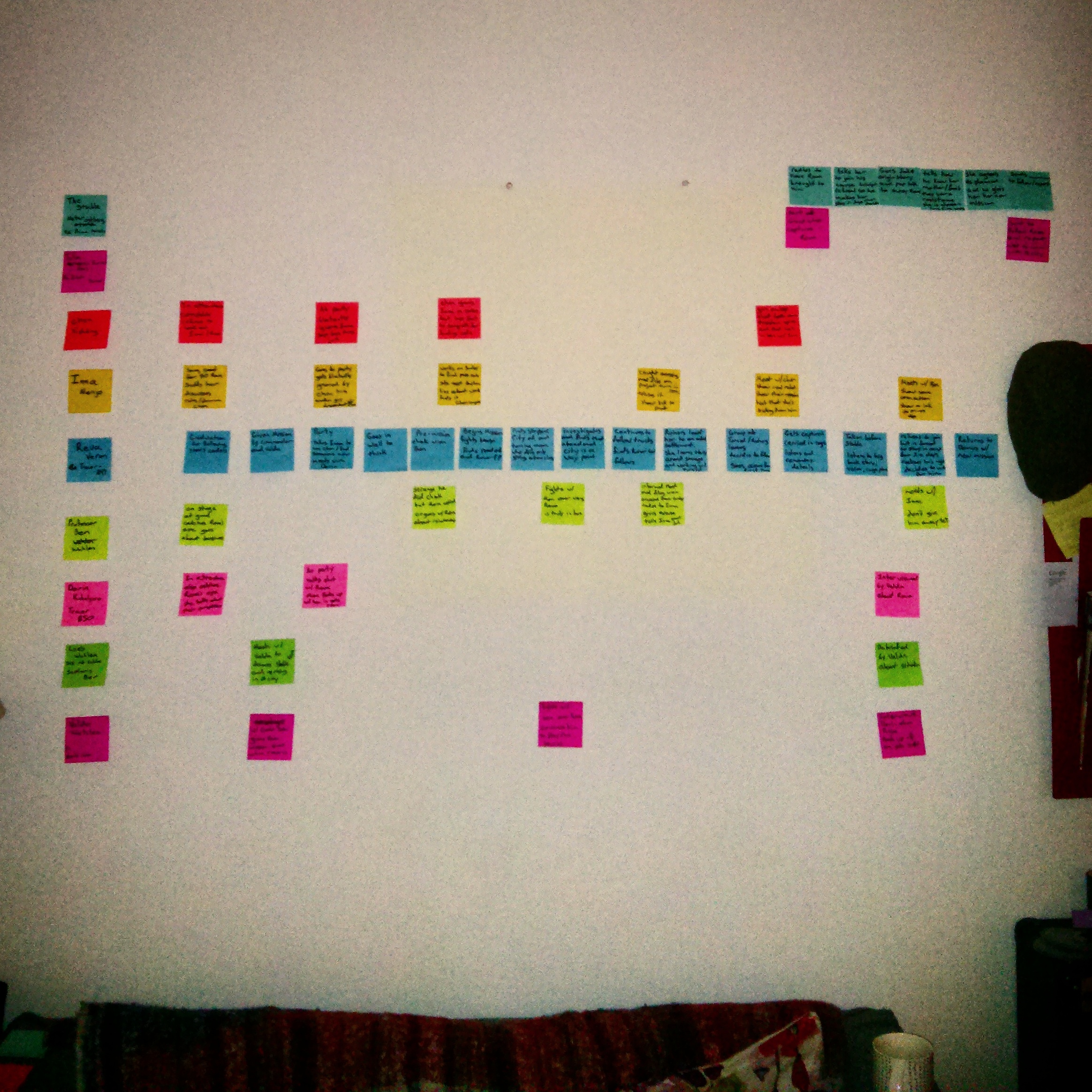
So a few months ago I got all excited and filled an entire wall of my apartment with multicolored sticky notes. It was beautiful and oh so satisfying to step back and see all of the planning I had just done. The problem was that there was no way I could make that process sustainable. It required too much paper, too much wall space, and too much time.

Sticky note wall

As I usually do, I wrote to my good friend, author of The Stars Were Right and Old Broken Road, K.M. Alexander to show off my masterwork. As he usually does, he gave me a great suggestion for a better tool. We both use Scrivener  as our primary word processor and the company who makes it also makes a helpful little gem called Scapple. It’s essentially a digital sticky note wall but with so many more great features.

Scapple Example

Sorry about obscuring the notes but I can’t go and give away my secrets now can I?

Anyway, this is just a small example of what you can do with Scapple. I’ve got the main characters on the left and I use lines to track their appearances throughout the scenes. The dark rectangles represent chapters and the stickies inside detail the general actions of each character that shows up in that chapter. I’ve also got some things going on with arrows but they are hard to see in the picture so we’ll just ignore that part.

I’m still somewhat new to the program so there is a lot I have yet to learn. Also, if you aren’t a fan of my green background, don’t worry, the default is white and you can either choose solid colors or use photos as a backdrop.

I’m not going to go into too much detail about the program as its website does a great job describing its many functions.

Scapple is available from good people at Literature and Latte. It’s affordable and you can download a free 30-day trial. In this case, each day you open the program counts as one of your thirty days so conceivably you can stretch the free trial out for much more than just a month.


I’m not working for Literature and Latte nor am I endorsed by them. This isn’t meant to be a commercial. Their products just kick ass and have made my writing life much easier so I thought I’d spread the word. Give it a try. Or don’t.

During one of my weekly writing group sessions, our host, outstanding author Hazel Manuel  brought up an idea that she and another of our colleagues discussed at a recent lunch (I’d name the other person but I haven’t been able to ask permission yet). This idea was to use the Myers-Briggs Test as a way to define the personalities of the characters in our stories.

So what’s the Myers-Briggs Test?

The Myers-Briggs is a personality test that was developed by mother/daughter dynamic duo of psychology Katherine Cook Briggs and Isabel Briggs Myers which expanded on theories first put forth by psychoanalyst Carl Jung. It uses a series of questions to place aspects of one’s personality into definable categories.

Each of the categories are assigned two letters of which the test taker will receive one depending on how the questions are answered. After all scoring is complete the subject will have a four letter code that can be used to further examine parts of their personality.

The letter pairs and their root words are:

Extraversion – Introversion

Sensing-INtuition

Thinking-Feeling

Judging-Perceiving

When I took this free online version myself, I discovered my code was ENTP. This wasn’t surprising. I’ve taken the test as part of various staff meeting activities in the past with similar if not the results. Repeatable results are the cornerstone of good science!

Now what does this have to do with our characters? (more…)